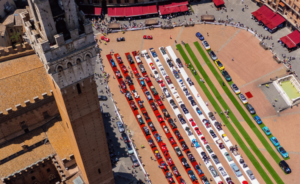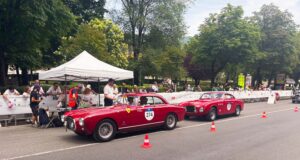
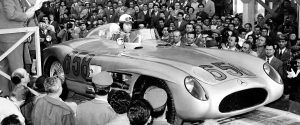
A 1950s Ferrari appears around the curve of Piazza del Campo in Siena. The light is perfect, the stone buildings glow in the afternoon sun, and for a few seconds it feels as though time has folded in on itself.
That is the Mille Miglia at its best.
The difference between an ordinary day at the rally and an unforgettable one is usually where you stand. The 2026 route passes through some of the most beautiful roads and historic towns in Italy, and a little planning transforms the experience completely.
This guide shows the best spectator locations for Mille Miglia 2026, how to choose between city centres, mountain roads and lunch stops, and how to photograph historic cars in a way that captures both the machines and the atmosphere that surrounds them.
The 2026 edition runs from 9 to 13 June, following the classic Brescia–Rome–Brescia figure-eight route.
The three types of Mille Miglia spectator spot
There is no single best place to watch the Mille Miglia.
A city square gives you atmosphere and architecture. A mountain road gives you speed and proximity. A lunch stop gives you time with the cars when they are stationary.
Understanding the difference makes planning much easier.
Historic city centres: the best atmosphere
Siena, Brescia, Rome and other historic towns along the route offer the classic Mille Miglia experience.
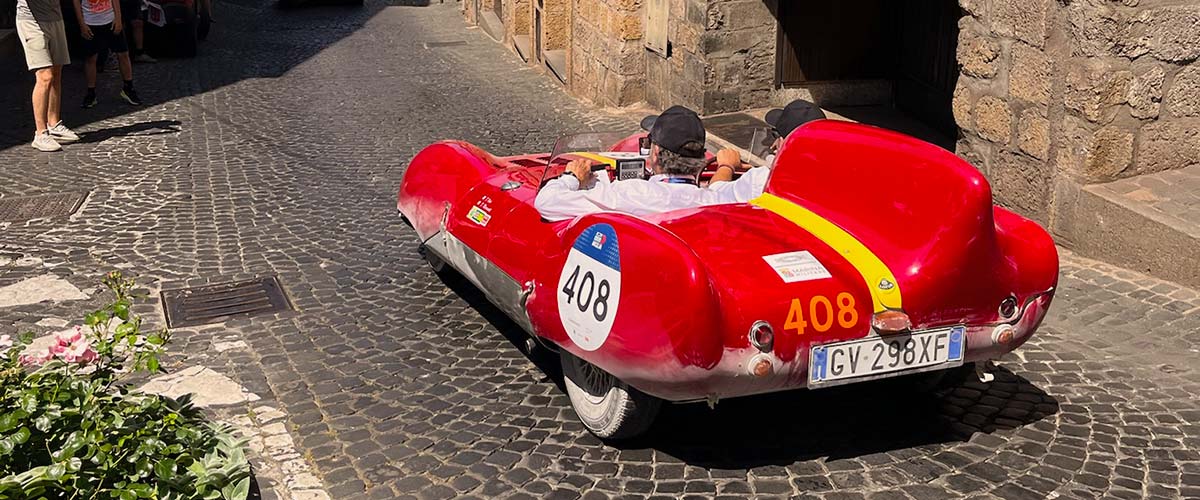
The cars arrive through streets that may be hundreds of years old, surrounded by stone buildings, cafés and crowds. The vehicles slow down considerably compared with the open road, giving spectators a much better opportunity to see the details.
For photographers, this is where the setting becomes part of the photograph.
A Ferrari, Alfa Romeo or Mercedes-Benz against a medieval Italian piazza tells a much stronger story than a car photographed against a modern roadside barrier.
Piazza del Campo, Siena
If you want one iconic location, Piazza del Campo in Siena is difficult to beat.
The sweeping curve of the square gives photographers several possibilities. You can frame a car against the Palazzo Pubblico, capture it entering the square or photograph the interaction between the cars and the spectators.
Arrive early.
The best positions disappear quickly, particularly around obvious corners and viewpoints.
Viale Venezia, Brescia
Brescia is where the Mille Miglia begins and ends, making it one of the most important places to experience the event.
The start has a completely different atmosphere from watching the cars on the open road. Teams prepare their cars, spectators gather and each vehicle receives its own moment as it leaves the ramp.
The finish is equally emotional.
If you only have limited time, Brescia is the obvious starting point. If you have several days, however, it is worth getting away from the crowds and seeing the cars in the countryside.
Tuscan roads: the best combination of cars and landscape
For many spectators, the Tuscan section is the highlight of the Mille Miglia.
The route passes through landscapes that have become almost synonymous with Italy: rolling hills, cypress trees, vineyards, stone villages and winding country roads.
The Crete Senesi and roads around the Val d’Orcia are particularly spectacular.
Here you are not simply watching historic cars.
You are watching them move through one of the world’s great driving landscapes.
This is also where photographers can create the most cinematic images.
Instead of filling the entire frame with the car, leave plenty of space around it. Let the landscape tell part of the story.
A small 1950s Alfa Romeo disappearing around a bend with the Tuscan hills behind it can be far more memorable than a close-up photograph of the same car.
Mountain roads and passes: the best for action photography
If your priority is action, head away from the cities.
Mountain roads, passes and narrow sections of the route give you faster cars, tighter corners and dramatic backgrounds.
The Furlo Gorge is one of the most spectacular examples.
The road narrows between the rock walls, creating a natural amphitheatre for the cars. There is little need for an artificial backdrop. The landscape does all the work.
Other rural sections of the route offer similar opportunities.
The key is to find a safe position with a clear view of the road and enough distance to react as the cars approach.
Never step onto the active road.
The Mille Miglia may be a historic rally, but these are still public roads with moving vehicles.
Lunch stops: the best place for close-up photographs
Lunch stops are completely different.
The cars stop. Engines cool down. Drivers and co-drivers get out. Mechanics check vehicles. People talk.
For photographers, this is arguably the easiest environment in which to capture the details that make the Mille Miglia special.
Look beyond the obvious photographs.
Photograph:
- A leather steering wheel
- An original dashboard
- A worn gear lever
- A Mille Miglia race number
- A driver’s gloves
- A mechanic working on an engine
- The bonnet raised on a 1950s sports car
- A driver studying the road book
- Reflections in polished bodywork
You do not need a long lens.
In many cases, a normal lens or smartphone is enough.
The important thing is to watch before photographing. The most interesting moments often happen after the initial crowd arrives and people settle into their routines.
The best photography positions
Knowing the location is only half the equation.
Where you stand within that location matters just as much.
At a corner
Corners are usually better than long straights.
A car approaching a corner gives you several moments rather than one predictable pass. You can photograph the approach, the turn and the acceleration away.
Position yourself beyond the apex where it is safe and permitted.
This gives you the chance to capture the car turning towards you rather than simply photographing its side.
At the exit of a corner
The exit can be particularly effective.
The car is beginning to accelerate, the front wheels may still be turned and the background often opens behind it.
For a photograph, this creates movement without requiring extreme shutter speeds.
With the landscape behind the car
Before choosing your position, look behind the road.
This is one of the most important photography tips at the Mille Miglia.
Ask yourself:
What will appear behind the car when it passes?
A clean hillside?
A medieval building?
A row of cypress trees?
Or a parked van, road sign and temporary fencing?
Move accordingly.
The best Mille Miglia photographs often come from choosing the background first and waiting for the car to enter the frame.
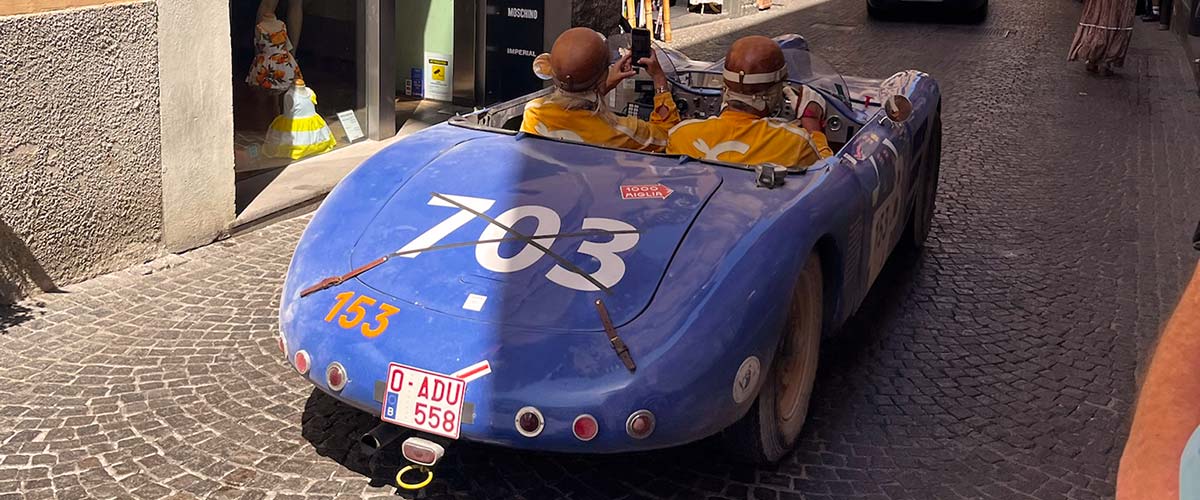
What camera equipment do you actually need?
You do not need professional equipment to photograph the Mille Miglia.
A modern smartphone is perfectly capable of producing excellent images at city stops, lunch breaks and close-range viewing areas.
For faster sections of road, however, a camera with a telephoto or zoom lens gives you considerably more flexibility.
A simple setup would be:
City centres: Smartphone or wide/standard lens
Lunch stops: Standard lens
Country roads: 70–200mm or similar zoom
Mountain roads: Telephoto zoom
Action sequences: Fast autofocus and continuous shooting
The most important piece of equipment is still your position.
A £5,000 camera in the wrong place will produce worse photographs than a phone in the right place.
Photographing moving cars
The cars can arrive surprisingly quickly.
If you are photographing from a rural section of the route, switch to continuous shooting and use a fast shutter speed if you want to freeze the action.
For a sense of movement, experiment with a slower shutter speed and pan with the car.
Panning takes practice.
Follow the vehicle smoothly as it approaches, keep your movement consistent and continue following through the exposure.
You will probably delete most of the photographs.
That is normal.
The one sharp image with the wheels blurred and the background streaking behind the car can be worth all the failed attempts.
The best time to arrive
Do not plan to arrive five minutes before the cars.
At popular locations, the best positions will already be taken.
For major city locations such as Siena and Brescia, allow 45–60 minutes or more before the expected arrival.
For rural locations, 20–30 minutes may be sufficient, depending on how popular the location is.
And remember that published times are estimates.
Traffic, weather, mechanical problems and delays elsewhere on the route can all change the schedule.
The safest strategy is to choose a good location, arrive early and settle in.
What should you bring?
You do not need a huge amount of equipment.
Bring:
- Camera or smartphone
- Spare battery or power bank
- Extra memory card
- Comfortable shoes
- Water
- Sun protection
- A lightweight rain jacket
- Telephoto or zoom lens if you have one
You can leave the large tripod at home.
Crowded viewing areas are rarely the place for bulky equipment, and a tripod will slow you down when you need to move.
A drone is also not something to bring into an active rally section. Follow all event restrictions and local aviation rules.
What not to do as a spectator
The Mille Miglia takes place largely on public roads, but that does not mean every position is safe or permitted.
Never step onto the active road to get a photograph.
Do not cross barriers or enter restricted areas.
Do not stand in a position where you could force drivers to alter their line.
Avoid using flash on approaching cars.
And do not push through a crowd because you arrived late.
The best Mille Miglia spectators understand that the event works because everyone gives each other enough space to enjoy it.
The moments between the cars
One of the biggest mistakes photographers make is concentrating entirely on the cars.
Look at the people too.
A father lifting a child onto his shoulders.
An elderly couple watching from outside their house.
A mechanic leaning over an engine.
A driver laughing with another competitor.
A café full of people waiting for the next car.
A deserted street immediately after the convoy has passed.
These photographs often tell the story of the Mille Miglia better than another photograph of a Ferrari.
The event is not just a collection of historic cars.
It is the relationship between those cars, Italy and the people who come out to see them.
How to see more than one section of the route
If you are travelling independently, resist the temptation to chase the cars constantly.
The Mille Miglia covers a huge distance.
Trying to drive from one viewing point to another every few hours can turn a spectacular Italian holiday into a stressful driving itinerary.
Instead, choose one region and explore it properly.
Siena is an excellent base for combining the rally with the Crete Senesi, Val d’Orcia and Chianti.
Brescia works well for the start and finish.
Other towns along the route can combine historic architecture, food and wine with the rally passing through.
The best experience is often to see the cars once or twice and then spend the rest of the day enjoying the region.
Should you watch the Mille Miglia independently or with a tour?
Watching from the roadside is free and can be incredibly rewarding.
But there is a major difference between watching the Mille Miglia and travelling with it.
An independent trip means finding accommodation, understanding the route, working out where to park, choosing viewing locations and planning how to move between stages.
A hosted classic car tour takes care of those decisions.
With a Nostalgic Mille Miglia tour, you can experience the rally from behind the wheel of a classic car, travelling alongside the official participants while your accommodation, route and logistics are organised for you.
For someone visiting from the UK, this can make particular sense if the goal is not simply to see the rally but to turn it into a proper Italian driving holiday.
The best spectator spot depends on what you want
There is no single answer to the question of where to watch the Mille Miglia.
For atmosphere: Siena or Brescia
For photography: Tuscan countryside
For action: Mountain roads and passes
For close-up details: Lunch stops
For the full experience: Combine the rally with a few days exploring Italy
The Mille Miglia moves quickly.
A car you have waited thirty minutes to see may be gone in ten seconds.
But that is part of what makes it special.
You hear the engine before you see the car. People turn towards the road. Cameras come up. The car appears, passes and disappears around the next corner.
Then everyone waits for the next one.
That is the Mille Miglia.
And if you choose your spot carefully, you will come home with photographs that feel like much more than photographs.
Mille Miglia 2026 Photography FAQ
Where is the best place to watch the Mille Miglia?
For atmosphere and architecture, Siena and Brescia are among the strongest choices. For photography and landscapes, the Tuscan countryside and rural sections of the route are hard to beat. Lunch stops are best for close-up photographs because the cars are stationary.
Can I watch the Mille Miglia for free?
Yes. Much of the rally takes place on public roads, so roadside viewing is generally free. Specific official areas, hospitality zones or restricted sections may have different access arrangements.
What is the best camera for the Mille Miglia?
You do not need an expensive camera. A smartphone works very well in towns and at lunch stops. For fast-moving cars on rural roads, a camera with a telephoto zoom and fast autofocus gives you a significant advantage.
How early should I arrive?
For major city locations, arrive around 45–60 minutes before the expected arrival time. For quieter rural sections, 20–30 minutes may be sufficient. Popular positions can fill much earlier.
Can I photograph the cars up close?
At permitted viewing areas and lunch stops, you can often get very close to the cars. Always respect barriers, officials, drivers and other spectators. Never enter the active road or restricted areas for a photograph.
Is the Mille Miglia worth visiting if I am not a car enthusiast?
Absolutely. The rally combines historic cars with Italian cities, food, architecture and some of the country’s most spectacular landscapes. For many visitors, the cars are only part of the attraction.
What is the best way to experience the Mille Miglia from the UK?
You can travel independently and watch from the roadside, or join a hosted classic car tour. A hosted trip removes much of the logistical work and allows you to experience the roads and atmosphere from behind the wheel rather than simply watching from the roadside.